PCI DSS Compliance Explained for Online Businesses
A comprehensive technical, operational, and regulatory guide to securing cardholder data and achieving PCI DSS compliance for e-commerce brands.
Read Strategy
A comprehensive technical, financial, and operational guide to the data flows, authorization lifecycles, and security protocols powering digital transactions.
For modern digital enterprises, executing a seamless online transaction appears instantaneous to the end user. When a customer clicks "Pay Now," a complex multi-party financial workflow triggers in the background, verifying account validity, evaluating fraud risk, and securing fund transfers within milliseconds across international banking networks.
In 2026, understanding the technical mechanics of online payment processing is essential for engineering resilient checkout funnels, minimizing transaction friction, and protecting operational margins. Rather than viewing payments as a simple black-box service, high-growth e-commerce brands must understand how data moves between browsers, payment gateways, acquiring networks, card brands, and issuing banks.
At TY ALPHA, TECHNOLOGY, we specialize in building fast, secure, and fully customized web development and payment infrastructure solutions. We have created this practical operational guide to give you an in-depth understanding of the payment processing lifecycle, key financial stakeholders, fee breakdowns, and step-by-step transaction execution pathways.
If you need professional assistance optimizing payment gateway integrations, building custom checkout pipelines, or troubleshooting processing errors, our technical team is ready to help. Simply click the link at the bottom of the page to connect with our solution specialists.
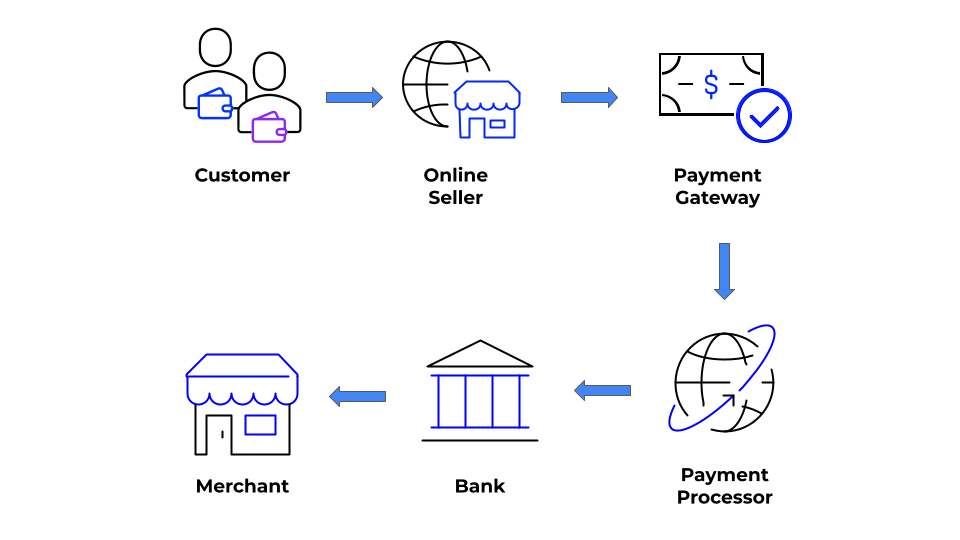
Every credit card or digital wallet transaction relies on an interconnected network of financial entities working in synchronization:
Financial transparency is vital for optimizing e-commerce gross margins. Whenever a payment is processed, the total processing fee is split among ecosystem participants through three primary components.
The largest portion is the Interchange Fee, paid directly to the customer's issuing bank to cover credit risk and card rewards. The second component is the Assessment / Scheme Fee, levied by card networks for utilizing their global network infrastructure. Finally, the remaining portion is the Processor Markup, charged by the acquiring platform or payment gateway for handling API routing, security compliance, and payout services.
At TY ALPHA, TECHNOLOGY, we help enterprise businesses audit transaction ledger fees, configure optimized gateway routing, and select pricing models (such as IC++) engineered to maximize overall profit retention.
Evaluating the distinct functional roles, technical responsibilities, and operational scope of core payment entities:
| Role / Entity | Primary Function | Technical Scope | Operational Responsibility |
|---|---|---|---|
| Payment Gateway | Captures, encrypts, and transfers frontend checkout payload data. | Client-side SDKs, tokenization APIs, micro-iframes, and webhooks. | Ensures PCI DSS SAQ A compliance and secures initial transaction payloads. |
| Payment Processor | Executes financial data transmission between gateway and card networks. | Backend ISO 8583 protocol communication and network authorization paths. | Manages transaction clearing, settlement schedules, and batch file handling. |
| Acquiring Bank | Receives settled funds on behalf of the merchant business. | Interbank clearing networks, SWIFT, and local automated clearing houses (ACH). | Underwrites merchant risk, holds merchant funds, and manages payout deposits. |
| Issuing Bank | Provides credit/debit facilities to consumers and evaluates balances. | Real-time account balance lookups, 3D Secure 2.0 authentication engines. | Authorizes or declines funds, manages chargeback disputes, and handles fraud claims. |
| Card Networks (Schemes) | Operates the global communication network linking issuers and acquirers. | Proprietary global payment rails and real-time transaction processing networks. | Sets interchange rates, defines scheme compliance rules, and maintains network standards. |
Behind the simple checkout button lies a two-stage financial lifecycle: Authorization (reserving funds) and Clearing & Settlement (moving actual money).
During authorization, sensitive primary account numbers (PAN) are instantly tokenized at the frontend to
protect cardholder privacy. The server submits the encrypted token via an /authorization API
request. Once approved by the issuer, a hold is placed on the consumer's account. Later, during the batch
settlement cycle (typically end-of-day), the merchant executes a /capture request. The processor
compiles captured batches, requests fund settlements across card networks, and deposits net funds into the
merchant's bank account via asynchronous webhook confirmations.
This decoupled two-stage architecture ensures ultra-fast checkout performance while safeguarding long-term backend accounting integrity.
Safeguarding transactions requires real-time risk assessment without degrading customer experience.
Modern payment processing architectures integrate Address Verification Service (AVS), Card Verification Value (CVV) checks, machine-learning risk engines, and 3D Secure 2.0 (3DS2) authentication. These systems evaluate dynamic parameters—such as device fingerprinting, velocity checks, and geographic IP matching—in real time to block fraudulent transactions before authorization while allowing legitimate customers to check out frictionless.
To illustrate the complete lifecycle of an online payment from click to settlement, we outline the exact 6-stage technical sequence:
The buyer submits payment details; client-side SDKs encrypt sensitive card data directly on secure hosted servers, returning a non-sensitive payment token.
The application server sends the token and order parameters via a secure REST API request to the payment gateway endpoint.
The gateway formats the payload into banking protocols and routes it to the acquiring bank, which forwards it to Visa, Mastercard, or local schemes.
The issuing bank evaluates account balance, performs 3DS fraud checks, and sends an immediate response code (Approval or Decline Reason) back through the network.
The merchant website receives the authorization response via API/Webhook in under 2 seconds, displaying the order confirmation to the customer.
The merchant triggers a batch capture request; funds are drawn from the issuing bank, routed through card networks, and deposited into the merchant account.
Mastering how online payment processing works empowers your business to build higher-converting, fully compliant, and revenue-optimized checkout funnels—ensuring max authorization rates and minimal processing overhead.
Whether you are configuring custom payment gateway integrations, implementing tokenized API workflows, or auditing payment processing performance, our developer team is fully prepared to assist. The technical specialists at TY ALPHA, TECHNOLOGY excel at engineering lightning-fast, highly secure, and conversion-focused web applications built for sustainable business growth.

A comprehensive technical, operational, and regulatory guide to securing cardholder data and achieving PCI DSS compliance for e-commerce brands.
Read Strategy
A comprehensive technical, financial, and operational guide to mitigating friendly fraud, optimizing dispute workflows, and protecting e-commerce margins.
Read Strategy