PCI DSS Compliance Explained for Online Businesses
A comprehensive technical, operational, and regulatory guide to securing cardholder data and achieving PCI DSS compliance for e-commerce brands.
Read Strategy
A comprehensive technical, financial, and operational guide to multi-processor payment architectures for scaling global enterprise brands.
Scaling a modern enterprise business across international markets requires a flexible, resilient, and intelligent payment architecture. As digital commerce expands across diverse geographic regions, customer preferred payment methods, and local regulations, relying on a single payment service provider (PSP) quickly introduces authorization bottlenecks, high transaction fees, and operational single points of failure.
In 2026, Payment Orchestration stands as the modern architectural standard for high-volume digital enterprises. Rather than locking your checkout infrastructure into a single vendor, a Payment Orchestration Platform (POP) acts as an intelligent abstraction layer that sits between your frontend application and multiple payment gateways, acquiring banks, risk engines, and fraud prevention tools. This centralized layer dynamically routes every transaction to the optimal processor in real time.
At TY ALPHA, TECHNOLOGY, we specialize in building fast, secure, and fully customized web development and payment infrastructure solutions. We have created this practical operational guide to give you an in-depth understanding of payment orchestration core mechanics, strategic financial benefits, gateway comparison parameters, and step-by-step implementation roadmaps.
If you need professional assistance designing custom payment routing rules, integrating multi-gateway APIs, or optimizing your checkout conversion performance, our technical team is ready to help. Simply click the link at the bottom of the page to connect with our solution specialists.
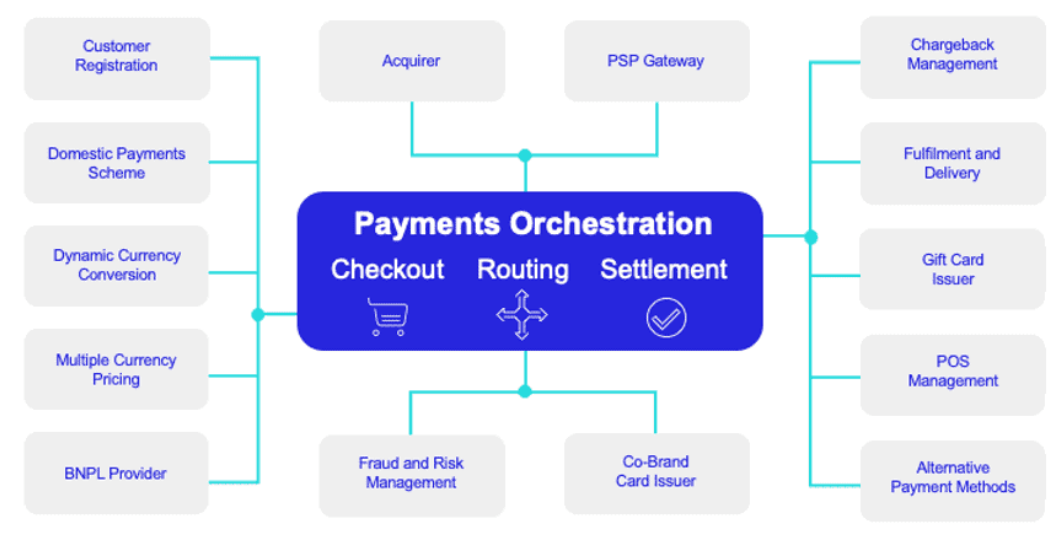
A unified payment orchestration layer delivers structural and operational advantages for enterprise e-commerce platforms, SaaS ecosystems, and global digital marketplaces:
Enterprise financial operations demand strict cost controls and full visibility into processing expenses. Payment Orchestration optimizes your payment unit economics by transforming payments from a fixed operational overhead into an automated cost-saving engine.
By evaluating transaction routes on a per-payment basis, an orchestration layer minimizes cross-border transaction fees by routing payments locally, reduces interchange markups, and prevents processor-side margin gouging. Furthermore, by managing dynamic fallback logic, orchestration directly recovers revenue from soft declines that would otherwise result in abandoned carts.
At TY ALPHA, TECHNOLOGY, we help enterprise businesses analyze processor performance, configure dynamic routing algorithms, and implement resilient payment architectures engineered for maximum profitability.
Evaluating the structural, technical, and operational differences between processing methodologies:
| Evaluation Criteria | Payment Orchestration Platform (POP) | Single All-in-One Gateway (e.g., Adyen / Stripe) | Custom In-House Multi-PSP Integration |
|---|---|---|---|
| Primary Target Audience | Enterprise brands operating globally across multiple gateways and high volumes. | Fast-growing SMBs, platforms, and mid-market merchants seeking setup simplicity. | Legacy enterprises with massive internal engineering resources. |
| Vendor Lock-in Risk | Zero; universal tokenization allows seamless switching or adding of new PSPs. | High; customer tokens and payment flows are tied to the vendor's proprietary stack. | Zero; fully owned, but requires ongoing internal maintenance and vault security. |
| Authorization & Failover | Automated, real-time dynamic routing and multi-PSP cascading on decline. | Single-provider routing algorithms; susceptible to single-point vendor outages. | Requires manual developer intervention and custom-coded routing logic. |
| Data & Analytics | Centralized multi-processor analytics reporting and unified reconciliation. | Comprehensive reporting isolated strictly to transactions processed on their platform. | Requires custom-built data warehouses to aggregate disparate PSP reports. |
| Maintenance Complexity | Low technical maintenance; new payment methods are added via unified POP APIs. | Low engineering maintenance; vendor handles protocol updates. | Extremely High; continuous API updates and PCI-DSS scope compliance required. |
Integrating a Payment Orchestration Platform into modern web applications simplifies frontend implementations while insulating your backend from diverse third-party API changes. POPs provide modular client SDKs and Drop-in UI components that securely capture payment details via PCI-compliant micro-iframes.
The client-side component generates an agnostic universal token directly via the orchestration layer. Your web
application receives this single token to execute payment requests against a unified RESTful
/authorize or /charge endpoint. The orchestration layer then evaluates business
logic, selects the optimal target processor, translates the request to match the specific PSP’s API spec, and
handles the handshake seamlessly. Asynchronous status updates—such as SETTLED,
FAILED, or CHARGED_BACK—are normalized and broadcast back to your application server
via a unified Webhook lifecycle.
This architectural abstraction guarantees lightweight frontend performance, eliminates custom code refactoring when adding new payment methods, and strictly maintains PCI DSS SAQ A compliance scope.
Scaling into new international territories requires deploying native payment preferences quickly without multiplying engineering debt.
Payment Orchestration enables instant activation of hundreds of global and regional payment methods—including digital wallets, local direct debits, Buy Now Pay Later (BNPL) schemes, and instant bank transfers—through a single integration layer. By decoupling payment options from individual PSP contracts, orchestration allows you to dynamically expose localized payment methods based on customer geography and device type, maximizing checkout conversion and consumer trust worldwide.
To systematically architect, configure, and launch a payment orchestration layer on your digital platform, we follow a structured 6-step engineering methodology:
Analyze historical authorization data, regional transaction distributions, current processing costs, and identify optimal PSP combinations.
Establish universal PCI tokenization vaults, configure multi-processor sandbox credentials, and establish unified API endpoints.
Embed lightweight, customizable client SDKs into your checkout funnel, applying brand styling while supporting dynamic payment method display.
Configure automated business rules for cost optimization, transaction threshold routing, regional acquirer matching, and cascading fallback logic.
Deploy secure webhook receivers with signature verification to handle normalized event notifications, automated retries, and ledger synchronization.
Execute synthetic stress tests, simulate gateway downtime scenarios to validate automated cascading, and switch live traffic to the orchestrated layer.
Implementing Payment Orchestration provides your business with a future-proof, highly resilient, and flexible payment engine—enabling seamless global expansion while boosting authorization rates and driving down transaction costs.
Whether you are scaling a multi-region e-commerce enterprise, modernizing legacy subscription systems, or unifying complex PSP networks, our engineering team is fully prepared to lead your integration. The developer specialists at TY ALPHA, TECHNOLOGY excel at building lightning-fast, secure, and conversion-optimized payment architectures engineered for long-term commercial success.

A comprehensive technical, operational, and regulatory guide to securing cardholder data and achieving PCI DSS compliance for e-commerce brands.
Read Strategy
A comprehensive technical, financial, and operational guide to mitigating friendly fraud, optimizing dispute workflows, and protecting e-commerce margins.
Read Strategy