Website Architecture and SEO: How to Organize Your Website

    Master the structural framework of modern SEO by engineering a clear, scalable website organization. Discover how strategic content hierarchy, internal link siloing, and crawl efficiency transform raw web pages into an authoritative organic search ecosystem.

    The Structural Advantage: How Website Organization Dictates Search Visibility

    For enterprise strategy directors, technical SEO leads, and web architects, achieving sustainable search authority requires far more than publishing isolated, keyword-rich content. The true determinant of organic scalability lies in website architecture—the systematic organization and structural design of your digital property. Website architecture dictates how search engine spiders crawl your pages, how indexation budget is allocated, and how topical authority flows across your entire domain. At TY ALPHA, TECHNOLOGY, we view site organization not as a static layout exercise, but as a critical engineering discipline that directly impacts your search rankings and user conversion efficiency.

    When a website lacks a clear organizational taxonomy, search engine crawlers struggle to map relationships between parent categories and supporting subtopics. This structural ambiguity results in inefficient crawl cycles, orphaned landing pages, and internal content cannibalization. Conversely, a carefully structured site establishes logical pathways that guide search bots through your content effortless, allowing them to index new URLs faster and pass link authority (PageRank) directly to high-value commercial landing pages.

    However, engineering an enterprise-ready website organization demands strict alignment between information taxonomies, URL routing, internal link silos, and user navigation frameworks.

    If you need professional assistance restructuring a complex domain, resolving structural crawl bottlenecks, or designing an enterprise-grade information architecture, our technical team is ready to assist. Click the link at the bottom of the page to connect with our web architecture specialists.

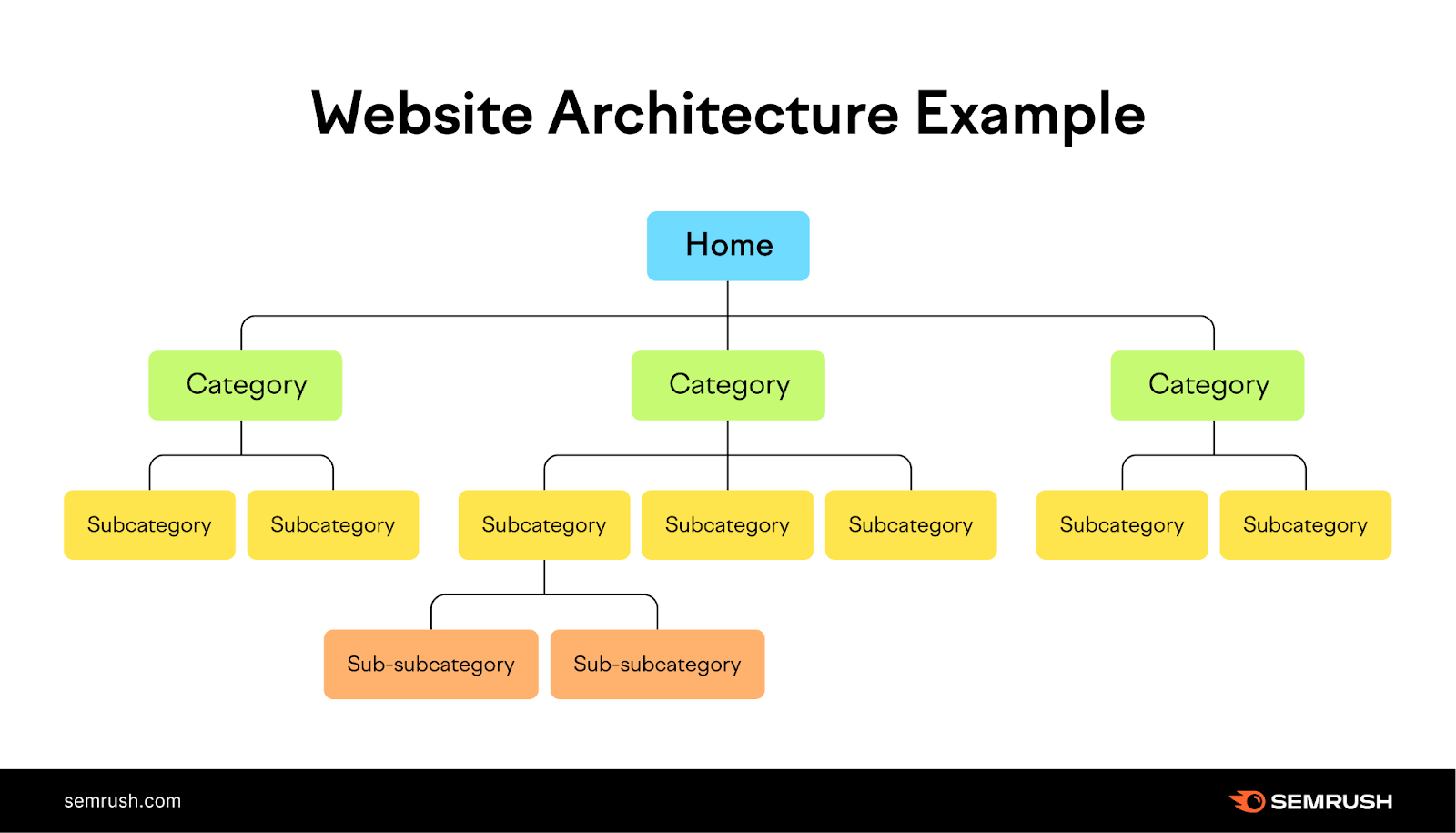
    Website Architecture and Information Taxonomy Systems by TY ALPHA TECHNOLOGY

    The Five Core Pillars of SEO-Focused Website Organization

    To build a scalable digital architecture that maximizes search crawlability and simplifies user journeys, development teams must execute these five core organizational pillars:

    • Pyramid Content Hierarchy & Categorization: Structuring site content in a clear top-down pyramid—moving logically from the homepage to core categories, subcategories, and individual pages.
    • Topical Siloing & Contextual Hubs: Grouping tightly related content assets into isolated thematic silos to build dense topical authority and signal deep niche expertise to search engines.
    • Intuitive Navigation & Breadcrumb Pathways: Implementing standardized primary menus, footer links, and schema-backed breadcrumb navigation to provide persistent context for users and bots.
    • Strategic Internal Link Equity Distribution: Leveraging targeted internal links with descriptive anchor text to pass accumulated domain equity from authoritative pages to deep, high-converting URLs.
    • Crawl Budget Optimization & Orphan Prevention: Eliminating dead-end pages, redundant parameters, and unlinked content to ensure search engine crawlers focus strictly on indexable, high-value assets.

    The Architectural Engine: Driving Domain Authority and User Engagement

    The primary business benefit of a well-organized website is the creation of a self-sustaining organic growth engine. By grouping pages into logical topic hubs, search engines easily identify your site as an authoritative industry resource, making it significantly easier to secure top positions for competitive short-tail and long-tail search queries.

    Furthermore, clear site organization fundamentally enhances user retention. Visitors can effortlessly navigate your digital ecosystem, find answers to related queries, and move seamlessly toward conversion touchpoints without encountering friction or dead ends. At TY ALPHA, TECHNOLOGY, we specialize in building clean, highly scalable web architectures that elevate search performance while providing exceptional user experiences.


    Website Organization Matrix: Models, Technical Requirements, and Outcomes

    This structured matrix outlines the primary organizational models, technical implementation considerations, and long-term search benefits of structuring your website effectively:

    Organizational Strategy Technical Implementation Focus Impact on Search Crawlability & Domain Equity
    Topical Siloing (Hub & Spoke) **Contextual Interlinking.** Connects supporting articles strictly to designated parent landing pages while minimizing cross-silo links. **Drives Deep Topical Relevance.** Prevents keyword cannibalization, establishes clear niche authority, and concentrates link equity within target content hubs.
    Flat Pyramid Hierarchy **Click-Depth Control.** Limits the navigation distance between the root homepage and deep content pages to a maximum of 3 to 4 clicks. **Optimizes Crawl Budget Allocation.** Ensures search engine bots discover and re-crawl priority pages faster without getting bogged down in complex subdirectories.
    Dynamic Breadcrumb Integration **Schema & Markup Sync.** Deploys JSON-LD `BreadcrumbList` structured data tied directly to dynamic site navigation trails. **Clarifies Site Relationships.** Helps search crawlers accurately map structural subfolders while enhancing SERP search listings with rich navigational snippets.
    Internal Link Equity Routing **Anchor Text & Placement.** Uses contextual, keyword-focused internal hyperlinks within body copy rather than relying solely on global navigation menus. **Directs PageRank Efficiently.** Channel authority from high-backlink assets (like popular blog posts) directly to conversion-focused product or service pages.

    Navigating Architectural Complexity: Avoiding Structural Disruption During Expansion

    As enterprise websites expand over time—adding new product lines, service categories, or international subdomains—their underlying architecture often suffers from "structural drift." Without strict governance, newly created pages get added haphazardly, leading to orphan pages, broken internal link hierarchies, and duplicate URL parameters that confuse search engine crawlers.

    Re-organizing an established web platform requires careful technical execution. Altering category structures, changing subfolder hierarchies, or updating URL taxonomies without meticulous 1-to-1 301 mapping can temporarily strip historical rankings and disrupt established indexing. To protect organic search revenue, any architectural overhaul must be guided by comprehensive pre-launch audits, crawling simulations, and post-launch monitoring.


    Organizing Your Website for SEO: A 6-Step Blueprint

    To organize, structure, and optimize your website architecture for optimal search engine performance, follow these six execution steps:

    1. Audit Existing Content and Identify Topical Clusters

    Crawl your domain to catalog every active URL, identify thin or duplicate content, and group existing assets into core business categories and supporting subtopics.

    2. Design a Streamlined Site Hierarchy Map

    Establish a logical top-down hierarchy (Homepage > Category > Subcategory > Detail Page) that keeps every essential page within 3 clicks of the root domain.

    3. Establish Standardized URL & Subfolder Taxonomies

    Define clear, static, lowercase URL paths (e.g., `/services/seo/website-architecture/`) that mirror your site hierarchy and communicate instant context to users and search bots.

    4. Build Contextual Internal Link Silos

    Implement structured internal linking between supporting subtopics and primary pillar pages, ensuring anchor text is descriptive and contextually relevant.

    5. Implement Breadcrumbs and Validate Structured Data

    Deploy user-facing breadcrumbs across all subpages and validate their JSON-LD markup to confirm search engines read the structural paths accurately.

    6. Generate XML Sitemaps and Monitor Crawl Health

    Submit updated XML sitemaps via Google Search Console, clean up 404 errors, eliminate redirect loops, and continuously audit crawl budget utilization.


    Ready to Architect an Enterprise-Grade Website Structure for Superior Search Performance?

    Organizing your website architecture is a crucial technical investment—it turns a chaotic collection of web pages into a streamlined, highly indexable growth platform that search engines respect and users love.

    If your organization requires an information architecture audit, structural migration plan, or specialized internal linking framework, we are ready to assist. The technical SEO and engineering team at TY ALPHA, TECHNOLOGY excels at transforming complex web properties into fast, beautifully organized search powerhouses built for long-term market leadership.